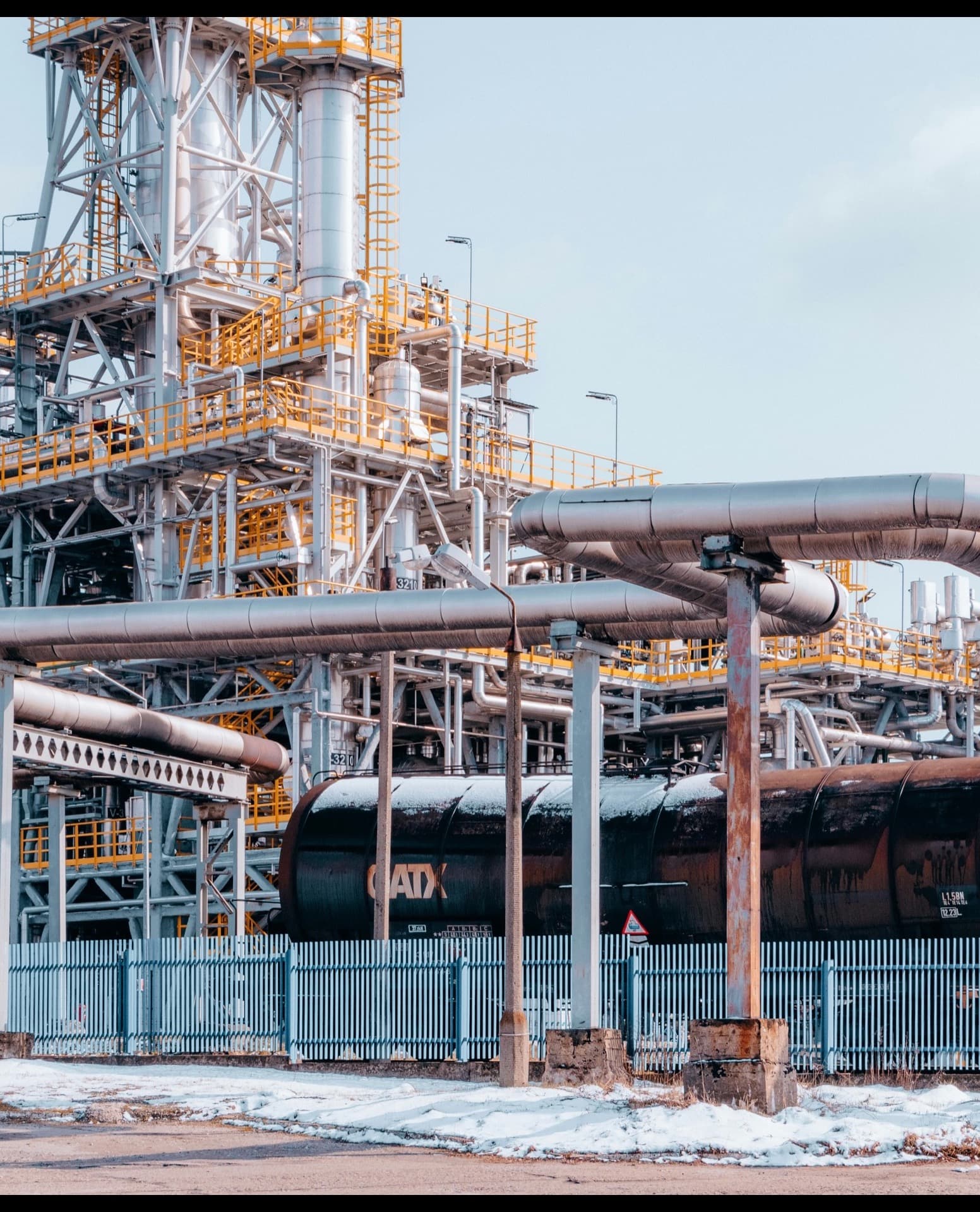
Piping is the part of a process plant that quietly accumulates the most risk. It runs everywhere, sees every service, crosses every unit boundary, and gets less attention per metre than any other piece of pressure equipment in the register. API 570 brings discipline to that sprawl, and in Jubail's petrochemical complexes, where a single train can carry tens of thousands of metres across hundreds of circuits, that discipline is what keeps the plant running safely.
This guide covers the parts of API 570 an operator decides on week to week: piping classes and intervals, circuitisation, condition monitoring location strategy, and dead-leg discipline.
Codes referenced
Piping classes set the inspection interval
API 570 sorts piping by the consequence of a leak, and the class drives the maximum interval. Get the classification right and the rest of the programme follows.
| Class 1 | Class 2 | Class 3 | |
|---|---|---|---|
| Consequence of failure | Highest | Medium | Low |
| Max thickness interval | 5 yrs | 10 yrs | 10 yrs |
| Max external / visual interval | 5 yrs | 5 yrs | 10 yrs |
| Typical service | Flammable / toxic | General process | Non-hazardous |
A line in good condition can still be Class 1 if a leak would be hazardous. Classification is set by service and consequence, then inspection frequency follows. Do not down-class a line because it has been reliable.
For context, here is where piping sits against the other in-service codes:
Source: API 510 §6.5, API 570 §6.3, API 653 §6.4. Default maxima; RBI may extend, remaining-life rule may shorten
Circuitisation: the decision that makes or breaks the programme
A corrosion circuit groups piping that shares the same material, service, and damage mechanism, so a representative set of readings can speak for the whole circuit. Draw the boundaries wrong and the data lies.
- Split circuits where service or metallurgy changes, even mid-run.
- Keep injection points, mix points, and dead legs in their own monitoring regime.
- Document the boundaries so the next inspector reads the same circuits you did.
CML strategy and dead-leg discipline
Condition monitoring locations should sit where corrosion concentrates, not on an even spacing. The two areas that cause most piping surprises deserve explicit attention.
Dead legs trap stagnant fluid and corrode faster than the live line. Corrosion under insulation (CUI) hides external wall loss under intact cladding. Both are easy to walk past and both have caused major losses. Build deliberate coverage for them into every campaign.
The failure is almost never the line everyone watches. It is the short dead leg nobody circuitised and the damp insulation nobody stripped.
The method behind each reading matters as much as its location. Our guide to NDT methods and standards used across KSA covers how ultrasonic, radiographic, and surface techniques map to piping damage, including CUI screening.
Welds and repairs
New welds and repair welds are where many in-service piping defects originate. API 578 covers material verification (PMI) to catch wrong-alloy components, and weld inspection records must flow back into the master integrity data system, not sit in a vendor's folder. The same reporting discipline we describe in the asset integrity management guide applies: a finding that never reaches the IDMS never informs the next interval.
How IES supports API 570 programmes
IES brings the inspection workforce and reporting rigour that large piping populations demand, from circuitisation through to weld and PMI verification. The pressure-vessel equivalent runs under API 510, and our buyer's guide to third-party inspection covers how to evaluate a provider. To scope a programme, talk to our team.
Questions buyers ask us
API 570 is the inspection code for in-service metallic piping systems. It governs inspection intervals, thickness monitoring, and repair for process piping after it enters service, classifying piping by the consequence of a potential leak.
API 570 defines three classes. Class 1 covers the highest-consequence services such as flammable or toxic fluids, Class 2 covers most general process piping, and Class 3 covers low-consequence, non-hazardous services. The class determines the maximum inspection intervals.
Maximum thickness inspection intervals are five years for Class 1 and ten years for Classes 2 and 3. External and corrosion-under-insulation inspections are five years for Classes 1 and 2 and ten years for Class 3. A risk-based assessment can adjust these within code limits.
Dead legs carry stagnant fluid where corrosion products and water accumulate, so they corrode faster than the live line yet are easy to miss. API 570 programmes need a deliberate process to identify, monitor, and where justified remove dead legs.